
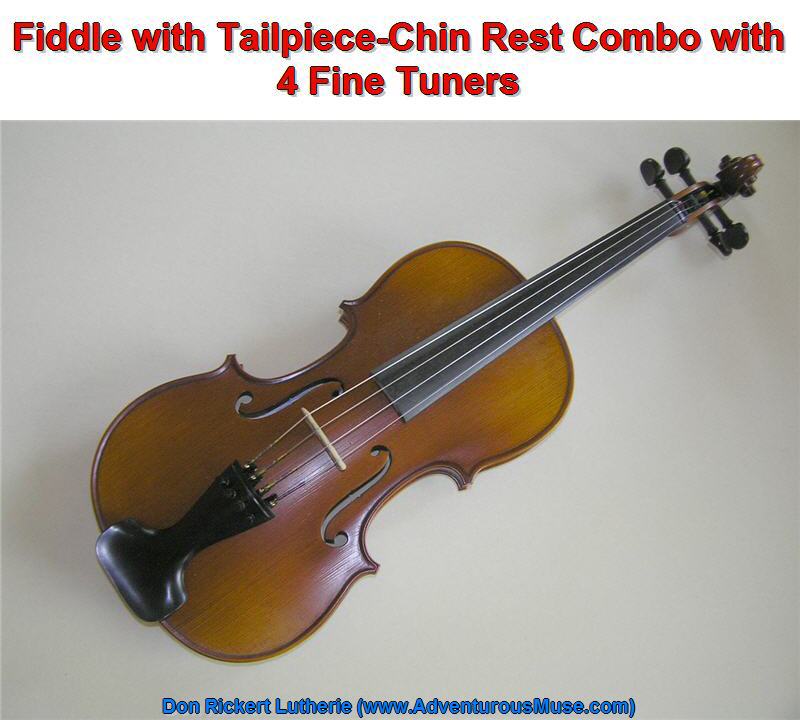
 In our very recent article, The Solution to the Chin Rest Problem on Backpacker Violins and Fiddles, I described Don Rickert Lutherie's quest for the solution to the chin rest problem with our backpacker and travel violins and fiddles. See that article for the details. The bottom line is that we have found a tailpiece-chin rest combo that is ideal for our backpacker and travel fiddles and that this accessory will also be of potential use to practitioners of American Old-Time fiddling and Irish Traditional Fiddling.
At the end of our last article, I alluded to the fact that we are now offering the Tailpiece-Chin Rest Combo accessory that is now part of the design of the Mountaineer III Backpacker Fiddle as an option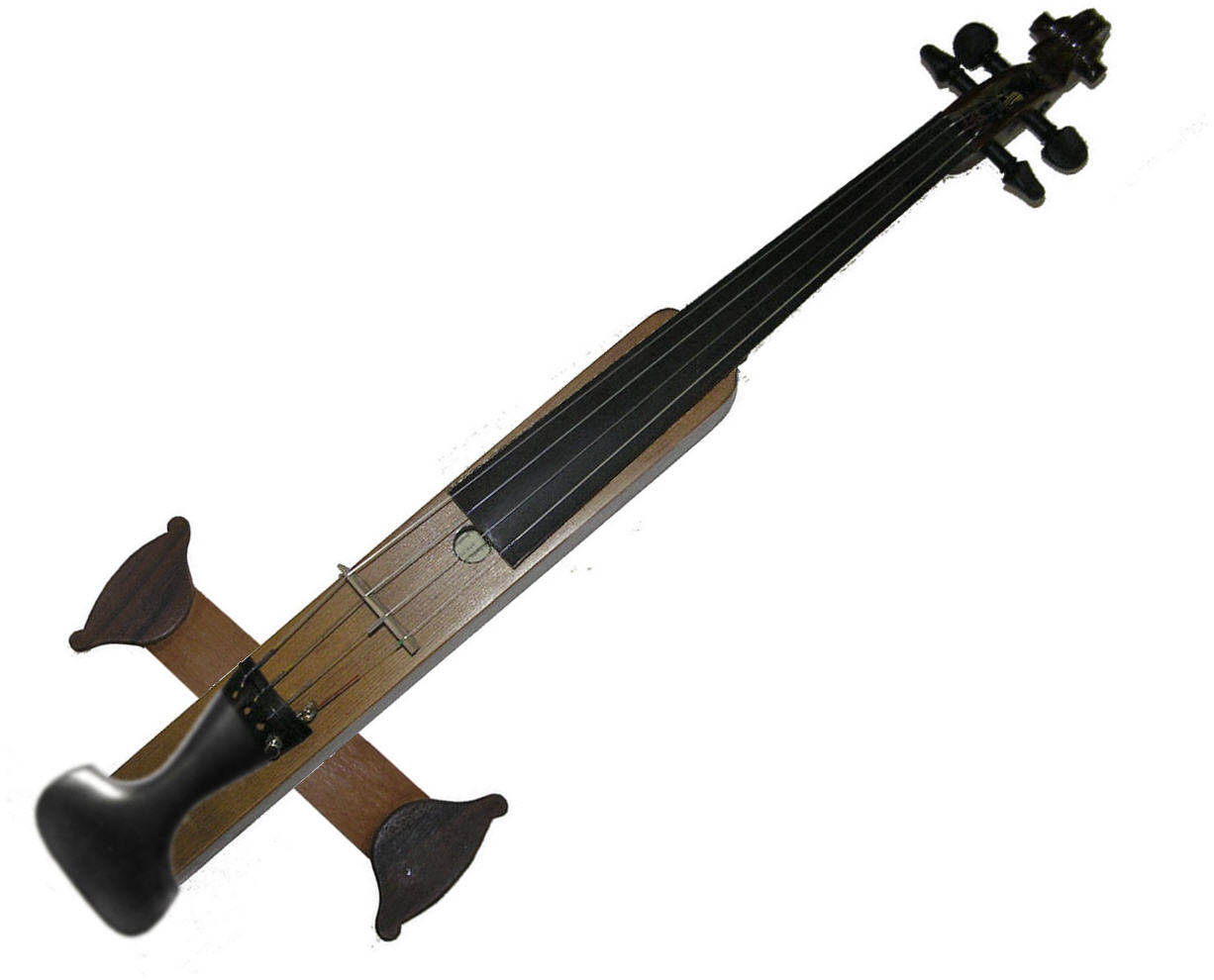 for our other backpacker fiddles and travel fiddles, as well as our regular fiddles set up for Irish Traditional Music or Old-Time playing. This would include:
- Dublin Pro Fiddle by Don Rickert Lutherie
- Fiddle Setup for Irish Traditional Music
- Rickert-Benker Fiddle w Celtic Setup by Don Rickert Lutherie
- Vintage Fiddle with Celtic Setup by Don Rickert Lutherie
- Classic Old-Time Pro Fiddle by Don Rickert Lutherie
- Old-Time Standard Fiddle by Don Rickert Lutherie
- Authentic Early 20th Century Old-Time Fiddle Setup
The Role of the Chin Rest in Old-Time and Irish Traditional Music
Chin Rest Use in Old-Time Fiddling: Old-School and Contemporary
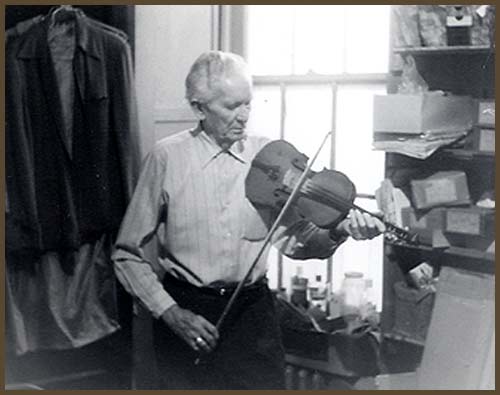 Most (but not all) American Old-Time fiddlers have a chin rest on their fiddles. Many Old-Time fiddlers, especially practitioners of the older style of playing, do not use the chin rest except maybe when they are tired (more or less as a very uncomfortable pillow :-)). Increasingly though, contemporary Old-Time fiddlers make occasional use of a chin rest to steady their instrument when playing in higher positions, typically 3rd Position. The return to 1st Position from 3rd Position is difficult without the assist of one's chin to hold the fiddle steady.
Side Note on Positions:There are 7 positions in which to place the left hand in violin playing. You can think of these 7 positions, by analogy, as 7 different sets of "home keys" on a typewriter or computer keyboard. Violin soloists, Jazz violinists/fiddlers and virtuoso Bluegrass fiddlers use all 7 positions routinely. In Old-Time, Irish, Scottish and other traditional fiddling genres, the most typical higher postion is 3rd Position. In 3rd Position, what would be the open string (in 1st Position) is a whole step higher (the equivalent a capo on the second fret on a mandolin). The fiddler often uses the right upper bout of the fiddle as a reference point for placing the heal of the left hand so that the fingers end up in the right places. It is not very difficult to "nail" one's fingers in the correct place for 3rd position. Moving back to 1st position quickly is a bit more difficult to learn and is almost impossible to do without hitting some bum notes (slang for sharp or flat), unless you hold the fiddle steady with your chin to do the 3rd to 1st Position shift.
Old-Time Fiddling used to be almost exclusively played in 1st Position. Playing in higher positions (particularly 3rd for Old-Time) is partly due to the fact that many younger fiddlers have some formal violin training and have embellished the older tunes with more complex "high parts" (i.e. playing the higher notes on the fiddle). This can only be done by moving one's hand from the standard Old-Time 1st Position to reach the higher notes.
I believe that at least an equally significant reason is the influence of Bluegrass fiddlers, many of whom are classically trained. The Bluegrass fiddling style demands extensive use of higher positions. There is much cross-over between Bluegrass and Old-Time fiddling. At officially-sanctioned Old-Fiddling competitions, Bluegrass style is often called "Modern Style" fiddling.
The Tailpiece-Chin Rest Combo Benefits for the Old-Time fiddler
For those Old-Time players who use the chin rest only occasionally, especially for the primary purpose of returning from 3rd to 1st Position, this accessory may be a more sensible way to go than a full-size chin rest. I have been playing with the tailpiece-chinrest for several weeks (Old-Time, Irish and even Scottish fiddling) and have found it affords much quicker "chin grabs" than a conventional chin rest, especially the larger types (e.g. flat and round Flesch and other center-mount types, Guarnieri and Strad over-the-tailpiece types, etc.)
Chin Rest Use (or non-Use) in Irish Traditional Fiddling
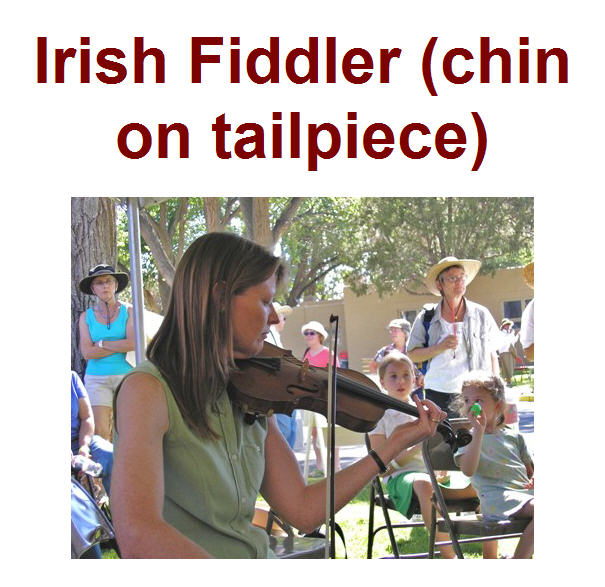
The story here is MUCH different! It is our observation, here in the U.S., as well as during frequent visits to Ireland, that many, if not most Irish Traditional Fiddlers do not use a chin rest at all. Rather, they use the tailpiece as the chin rest. This is the way that fiddle in Irish Traditional Music is played much of the time. See the following photos for illustration.

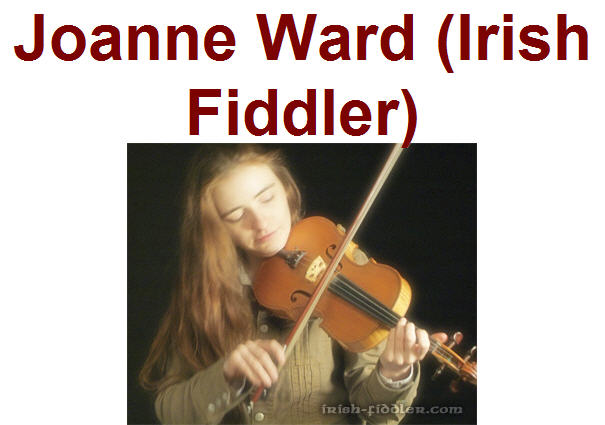
Of course there are many Irish Traditional Fiddlers, as well as the majority of Scottish and Scots-Irish (Ulster), who play violin style using a chin rest; however, it is hard to find an Irish player who does so. Indeed, the way the fiddle is held, together with bowing technique, are two of the principal differentiators between Irish and Scottish/Ulster fiddling. Some photos of typical Scottish playing style appear below:



For the Irish Traditional Fiddler who plays chin-on-tailpiece, this Tailpiece-Chin Rest Combo could be life-changing. You hold and play your fiddle the way you always have; however, instead of stabbing your chin with a regular tailpiece, you have a mini-chin rest in just the right place. How much better could it get?
One of Our Fiddles With the Tailpiece-Chin Rest Combo
Here are some photos of the Tailpiece-Chin Rest Combo on a Christian Benker violin set up for Old-Time and Irish fiddling.
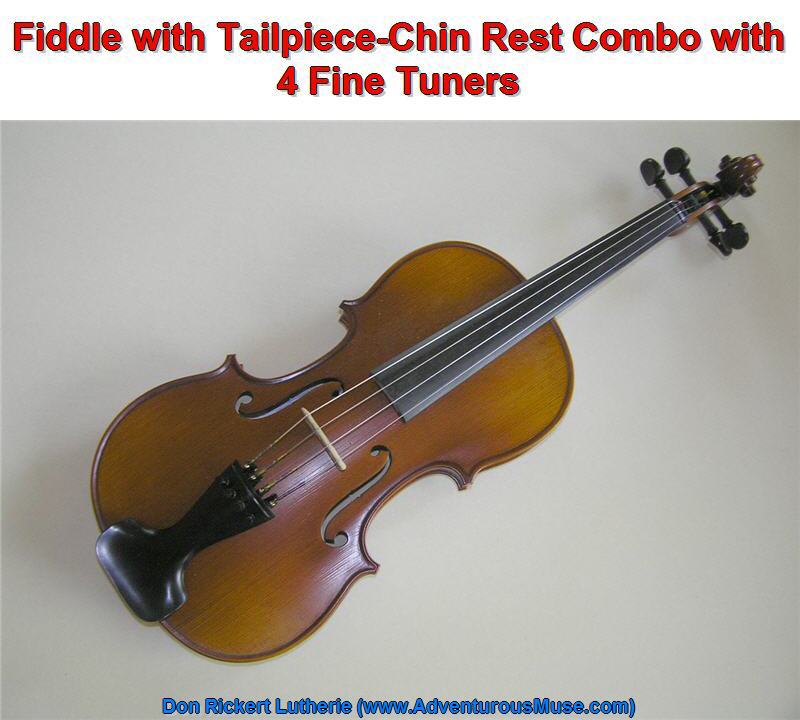
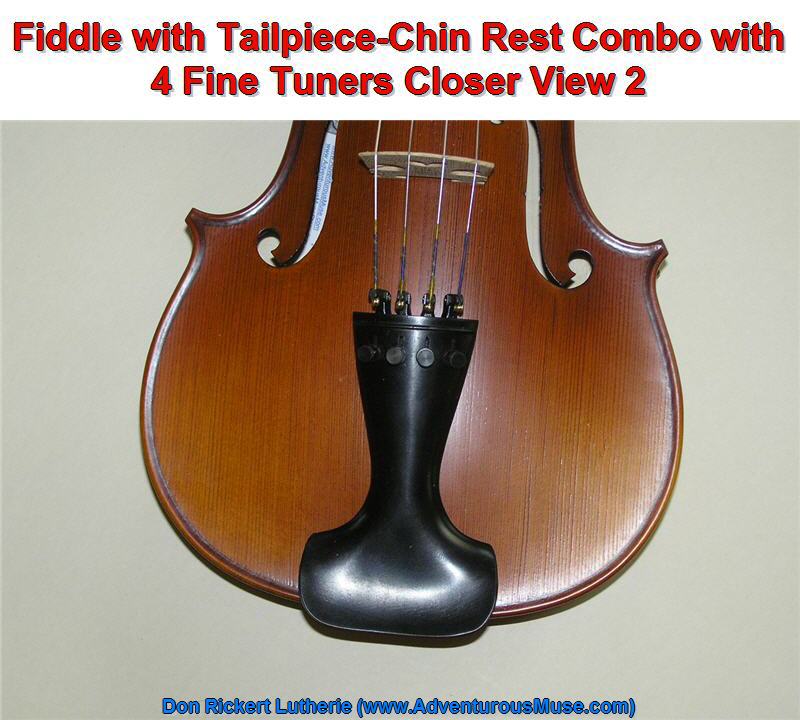
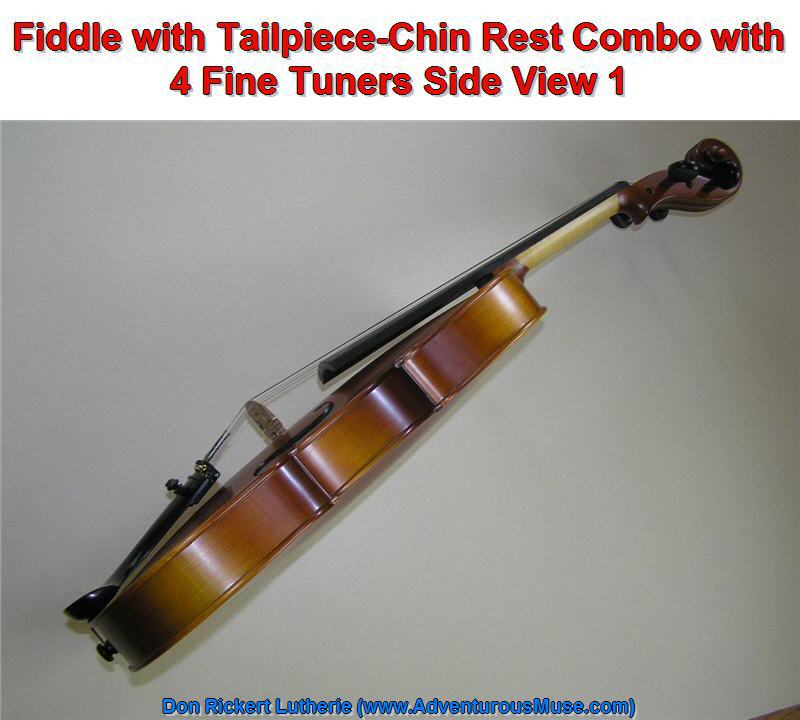
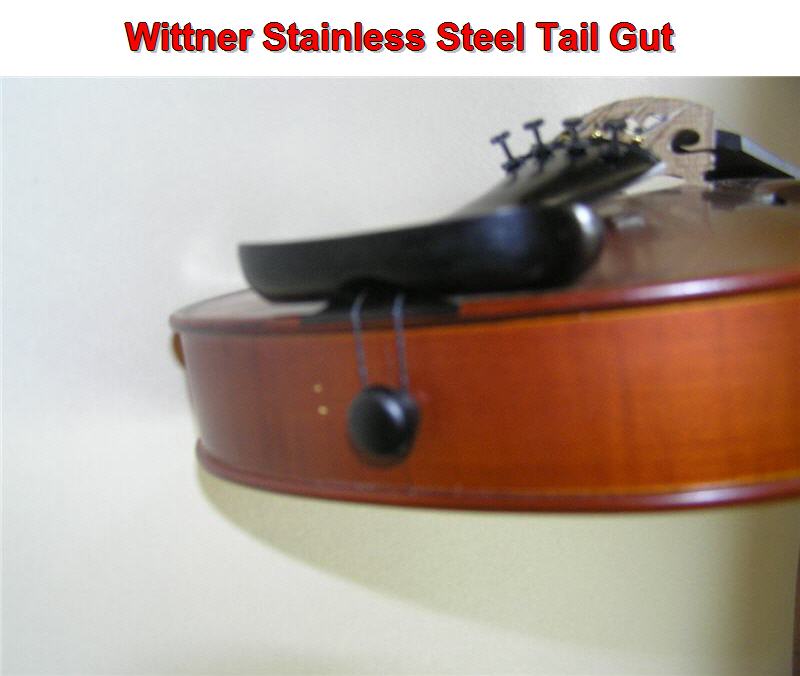
To find out more about this fiddle setup, see: A Regular Fiddle with the Innovative Tailpiece-Chin Rest Combo.
 D Rickert Musical Instruments
Leave a comment