
Introduction
Innovations the realm of musical instruments, as with all other areas of invention, are often inspired by very old ways of doing things. It may be the materials used or it could be a variation of implementation that takes into account other discoveries subsequent to the original invention that transforms the old invention into something completely new. In the world of Intellectual Property (i.e. Patents), many patents are for improvements upon old inventions rather than completely new inventions.
Take the case of some of the octave (baritone) violins and fiddles by Don Rickert Lutherie. Several of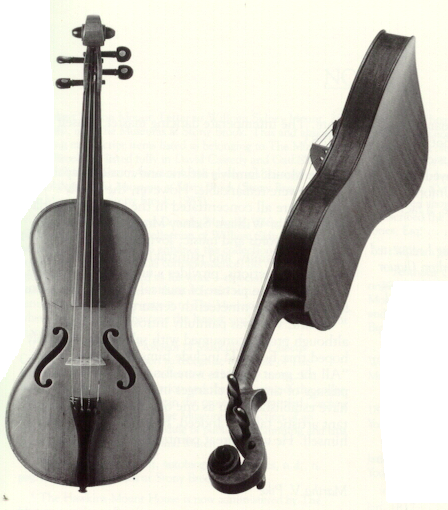 our octave violins are inspired by a U.S. Patent obtained in 1852 by the Artist and Inventor, William Sidney Mount. Mount had the idea that a violin with a top of flat spruce with a convex (outward) bend and and back of CONCAVE (inward) bent maple, rather than either the top or back having traditional carved arching, would be much more sonorous (and extremely loud) than a traditional violin. Due to the concave backs of these unique violins, they are sometimes called "hollow back" violins.
There were problems with Mount's instruments arising from use of a mid-19th Century bass bar and lousy glue (by today's standards). Further, the bent top and back plates required ribs (sides) and linings (the wood strips glued to the edges of the ribs to provide a larger gluing surface for the top and back) with extremely complex curves and beveling. Glue failure was the ultimate result and only several of the original instruments are still playable.
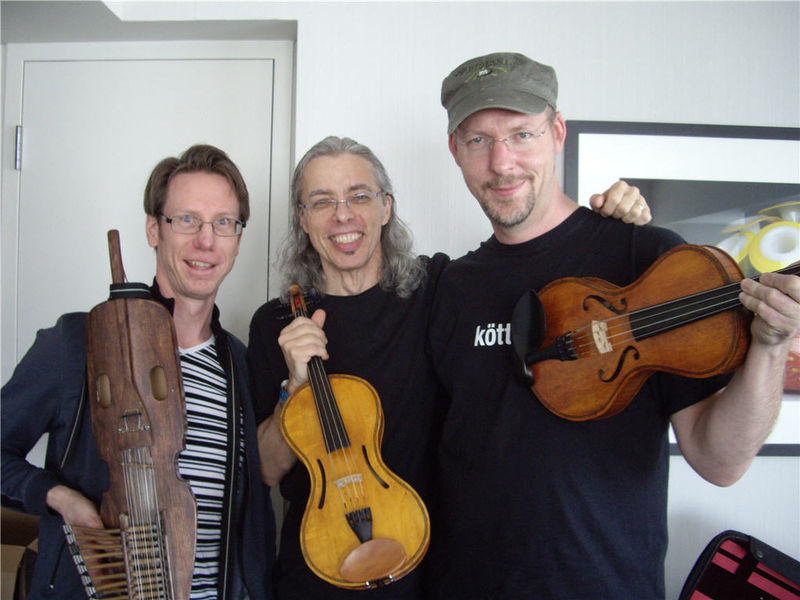
Combining Mount's basic ideas with the use of modern glues, special CAD-designed construction jigs to produce perfectly-mated (i.e. no gaps) gluing surfaces, contemporary knowledge of bass bar design and Carleen Hutchins' discoveries with respect the relationship of internal air volume to sound hole size, we were able to invent the most powerful and easy-to-play octave violins available today. Photos of two Rickert-Fiddarci (a joint venture of Don Rickert Lutherie and Fiddarci Lutherie) appear below…Darol Anger with the light amber octave violin (Darci Jones Model) and the fiddler of the Swedish band Vasen holding another (W.S. Mount Model). The other instrument is a kind of Swedish keyed fiddle called a Nycelharpa (we do not make these).
Other Examples:
- The carbon fiber violin
- The carbon fiber fabric-Kevlar core violin bow
The Violin Tail "Gut" (a.k.a. "Tail hanger", "Tail wire" and "Tail Cord")
The tail gut secures the violin tailpiece to the end pin (a.k.a. tail button). This much taken-for-granted accessory is more important than most musicians realize. Assuming a properly set-up violin (i.e. bridge, sound post, etc.) or fiddle of at least moderate quality with decent strings and a good bow, NOTHING enhances (or diminishes) the sonority of a violin or fiddle than the adjustment of the tail gut and the material from which the tail gut is made!
Part 2 of this article will get into the details of the new state-of-the-art in tail guts. You will be surprised by its Baroque violin roots.
 D Rickert Musical Instruments
Leave a comment