
Introduction
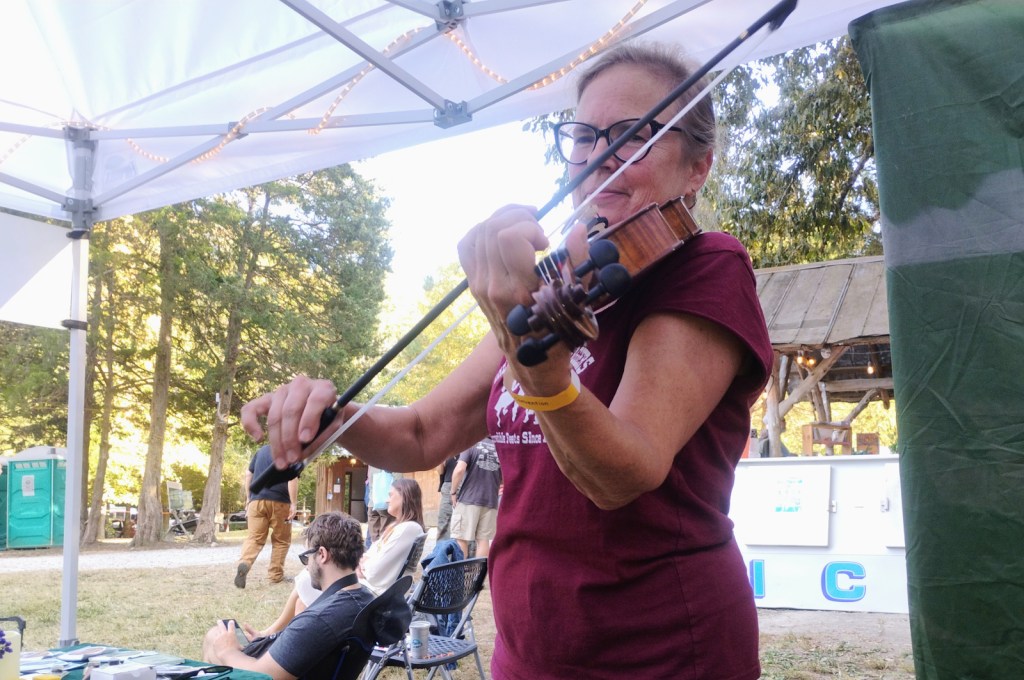
Anyone who has followed this blog for the past 15+ years or has ever spoken to me about musical instruments will know that I am passionate about Octave Violins, which are regular violins modified and fit with special strings to play one octave lower. They are between violas and cellos pitch-wise. They, the good ones at least, sound more like a cello than a viola. But they are still about the same size, albeit, often with a deeper body, as a plain old fiddle.
For a violin sized instrument to play notes almost as low as a cello without electric amplification was barely possible even two decades ago. One thing that has changed is string technology. Octave Violin strings available today were only a dream as recent as 15 years ago. The dream has always been excellent tone, playability and acoustic volume (i.e. without a pickup and amplifier).
A more significant factor, I opine, is the effect of a small number of obsessed weirdo luthiers who are, or appear to be, well-versed in the philosophy and methods of science-based iterative experimentation. Besides myself, I wish to acknowledge the contributions of Tim Phillips, David Ravinus and Eric Aceto. I apologize for my ignorance with respect to other trailblazers. Please let me know if there are others I should recognize in a comment, or call, email or text me.
The discoveries making today’s generation of world-class purpose-built octave violins possible have to do with the following enhancements to violin design:
- The bass bar
- The soundpost and its optimal location for octave instruments
- Plate-tuning and graduation of the instrument top and back
- The contribution of deeper ribs to tone and volume
- Body shape
- Sound hole size and shape
- The Bridge
Not an orchestra instrument
The Octave Violin has never been included in orchestras, at least in the configuration that has existed for two centuries. Rather, Octave Violins, are used for almost every genre besides orchestral music. Three of these are Celtic Traditional, Old-time and Bluegrass. But let us not forget New Age, World, Jazz and other folk genres.
Want to know how good the Double Fat-Strad Octave Violin sounds?
The Double-Fat Strad Octave Violin is the absolute state-of-the-art for acoustic Octave Violins. Here are 3 new videos of the new Double-Fat Strad Octave Violin in the hands of really good players. Two of these new videos are Old-Time fiddle tunes and the other features snippets of two Traditional Scottish Highland tunes.
If you wish to discuss this instrument or a completely new build, I look forward to hearing from you.
Contact Information
The web address for the “Cool Instruments for Hep Cats” video podcast is: @Cool_Instruments_for_Hep_Cats – https://www.youtube.com/@Cool_Instruments_for_Hep_Cats/podcasts
Don Rickert’s main website, ‘D. Rickert Musical Instruments’, is https://www.RickertMusicalInstruments.com.
Online store, ‘Don Rickert Musician Shop’, is https://www.DonRickertMusicianshop.com.
Don Rickert on Linktree: https://linktr.ee/donrickert. This link gets you to ALL of my detailed contact information, my websites and social media.
Email: don@donrickertdesign.com; doctorfiddle@gmail.com
Phone (in US): 706-400-1481 (mobile)
 D Rickert Musical Instruments
Leave a reply to Instruments Completed in 2025 to Date – D Rickert Musical Instruments Cancel reply