
Introduction
The history of innovation is fraught with examples of great products that depend on materials or parts from completely different industries. For example, electric cars are totally dependent on advanced battery technology, which is, itself dependent on rare earth elements like lithium! The electric car industry is apparently succeeding. Hydrogen-powered cars, not so much.
In the parlance of Theory of Innovation, there is something called the “Chicken and Egg Dilemma” or “Infrastructure Gap”: For example, hydrogen-powered vehicles are highly efficient and clean, but consumers won’t buy them without hydrogen fueling stations. Conversely, energy companies won’t build fueling stations until there are enough hydrogen cars on the road.
The point is that things can go either right in the end or not. The situation with strings for alternative low-pitched instruments like octave violas and violoncellos is similar. Those who make alternative bowed string instruments are, as far as I can tell, ALL working on the problem. Read on . . .
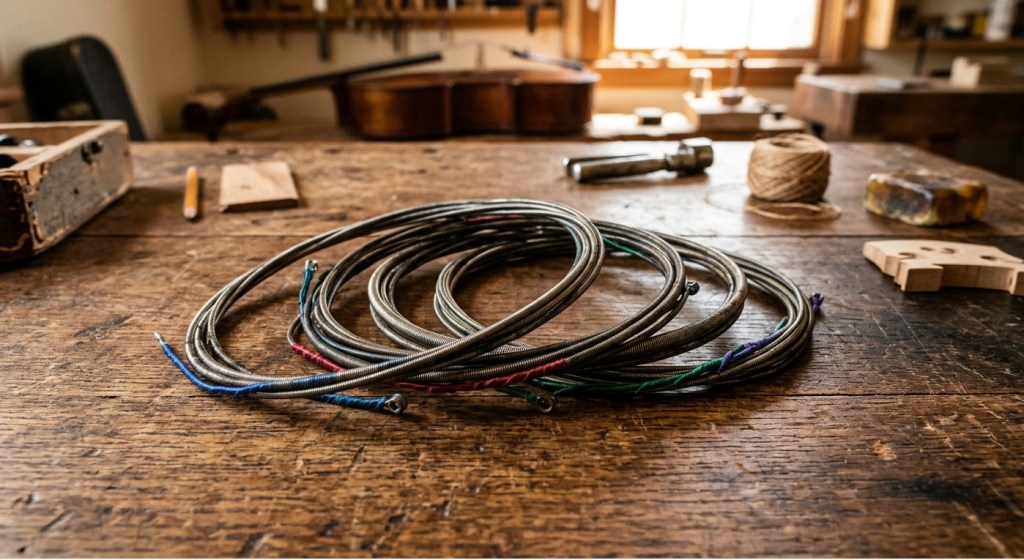
The String Problem
If you either own or are thinking of acquiring a tenor/baritone range alternative bowed instrument, you know that strings are problematic for several reasons. I am talking specifically about the following instrument types:
Note: the number suffixes on the pitches (e.g. G2) indicate the octave. For reference, middle-C is C4. A regular violin is tuned G3 D4 A4 E5. Middle-C is the third finger position on the A-string.
- Tenor Violas (tuned G2 to E4)
- Octave Violas (tuned C2 to A3) and 5-string Octave Violas (Tuned C2 to E4)
- Violoncellos da Spalla (5-string, tuned C2 to E4, often to an historic pitch standard, such as A=415 Hz).
The ONLY tenor range bowed instruments for which strings are NOT a problem are Octave Violins, as excellent purpose-made strings are readily available (e.g. D’Addario Helicore Octave Violin Strings), at least for now. The now-defunct Sensicore Octave Violin strings were the earliest manufactured option.
Note: Back in the early days of the modern Octave Violin (early 2000s), there we NO manufacturers of octave violin strings. Most octave violin early adopters used a weird combination of viola and cut-down cello strings per an article published in Strings Magazine by the famous fiddler Darol Anger (‘Another Voice: the Baritone Violin’, originally published in Strings Magazine (Sept/Oct 1992). [1, 2])
Further Note: There are currently two manufacturers of Octave Violin strings, D’Addario (less than $100/set) and Thomastik ($225+/set). This writer prefers the D’Addario Helicores for sound and playability, as well as price. There are, I understand, different opinions.
Must Read!
For a comprehensive discussion of the string availability problem specific to the Violoncello da Spalla, you should read the article: ‘Violoncello da Spalla Strings Update’ by Daniela Gaidano and A. Visintini.
Daniela Gaidano is a luthier who makes wonderful Violoncellos da Spalla and is also a widely-respected thought leader on all things having to do with the instrument, especially strings.
I will attempt to succinctly summarize the keys points of the article below.
Gaidano and Visintini article key points
Violoncello da Spalla is used for many musical genres.
Wide variation in player genre focus. Some players use the Violoncello da Spalla almost exclusively for historically-correct Baroque performance. Others use the instrument for everything but Baroque. One group tends to prefer historic type gut strings and the other, modern metal, synthetic or silk-core wound strings.
The Main String Manufacturers
Until now we had the choice of 3 manufacturers:
- Aquila Corde Armoniche
- Atelier Boussoir
- Thomastik Infeld
The breaking news is that Thomastik-Infeld strings for Violoncello da Spalla are discontinued. So now there are just two.
Manufacturing costs are rising
Due in part to geopolitical events (the pandemic, wars, tariffs), the cost and availability of materials is rising exponentially. This includes materials for modern strings (e.g. tungsten, copper, aluminum, titanium) and historic strings (e.g. animal gut, silver)
Not worth the trouble for major string manufacturers
Recall the “Chicken and Egg Dilemma” mentioned earlier. This appears to be the primary reason for Thomastik-Infeld discontinuing its Violoncello da Spalla strings. There are many other manufacturers who could make great strings for the instrument, but have shied away from that line-of-business. The list includes:
- Warchal
- Dogal
- Pirastro (historic and modern gut core)
- Larsen
I would add—
- D’Addario
- Prim
Also, another US-based boutique maker of historic gut strings, Gamut, has walked away from the Violoncello da Spalla string market.
The various technical issues for large-scale string manufacturers
The Gaidano and Visintini article goes into detail about the reasons that making special items like violoncello da spalla strings is difficult for string manufactures. Such as . . .
- Sourcing animal intestines (sheep, bovine, etc.) for making gut is extremely hard. Laws and regulations are constantly changing. Quality control verges on the impossible—animal guts vary widely in usability for strings.
- The meteoric rise in the price of silver for windings
- Same for tungsten, aluminum and copper
- Scale—machinery for making gut or modern violoncello da spalla strings needs to be specially calibrated for small runs of only several dozen special strings.
- Machine resources are diverted for more than day, when hundreds or even thousands of “normal” strings could have been made. Corporate bean counters (i.e. accountants) do not like this.
- Distributors are averse to stocking niche items in general, especially strings.
- Technical difficulties related to designing and making unusually low-pitched strings that sound right and are also playable, and do not break due to too high tension.
- Basically, the physics part is challenging. The usability research with actual players is even more difficult. Gaidano and Visintini delve into all of this in great depth.
There is so much more, so you should really read the original article.
Gaidano and Visintini conclude by describing the great efforts of Gaidano and Visintini and other experts in the violoncello da spalla world to repurpose various existing viola, cello and even bass strings for the violoncello da spalla. In the meantime, rest assured that there are still some excellent strings, gut as well as modern, which, while expensive, are available:
- Aquila Corde Armoniche is offering two sets: an historical one with gut core, and a modern one with synthetic core.
- Atelier Boussoir is offering a set of historical basses with a gut core, a special C string with tungsten and silver winding, and another set of historical basses on silk core. Plus, a modern complete set of all five strings wound on silk core.
Conclusion
I have found a small US-based string manufacturer who can supply an excellent set of affordable (<$100) modern synthetic core strings for Octave and Tenor Violas right now. We are cautiously optimistic that the manufacturer can supply a slightly longer string set for violoncello da spalla, at a reasonable cost (about $130 per set), maybe even less.
We are also exploring string sets for Octave Viola, Tenor Viola and Violoncello da with braided steel cores, similar to Helicores.
Please stay tuned.
Contact Information
The web address for the “Cool Instruments for Hep Cats” video podcast is: @Cool_Instruments_for_Hep_Cats – https://www.youtube.com/@Cool_Instruments_for_Hep_Cats/podcasts
Don Rickert’s main website, ‘D. Rickert Musical Instruments’, is https://www.RickertMusicalInstruments.com.
Online store, ‘Don Rickert Musician Shop’, is https://www.DonRickertMusicianshop.com.
Don Rickert on Linktree: https://linktr.ee/donrickert. This link gets you to ALL of my detailed contact information, my websites and social media.
Email: don@donrickertdesign.com; doctorfiddle@gmail.com
Phone (in US): 706-400-1481 (mobile)


Leave a Reply