
Part III
This is a continuation of Part II, which focused on attributes of the strings and the instruments themselves vis-à-vis premature string breakage. Part III focuses on what can be done about it.
Part III: Changes to instruments that will decrease premature string breakage
Make thinner strings?
Reducing the diameter of strings would improve string longevity. That is not going to happen in any plausible version of the future.
It is possible to make thinner C and G strings.
Remember, there are three key independent variables for determining the necessary string diameter for a given pitch: mass (weight), length and diameter. Using heavy winding materials such as tungsten makes a smaller diameter lower pitch string.
That being said, attributes such as timbre (tone) and bow response for a thinner string will be different in unpredictable ways. Also, a thinner string will have a wider “vibration arch” than a thicker string. This can result in fingerboard “buzzing”. Even so, I have determined that a custom long length violin F-string (for 6-string electric violins) by Prim works surprisingly well as a Violoncello da Spalla C-string. It has a diameter just over 1.3mm! Getting such strings manufactured is a long-term possibility at best, as tried-and-true formulas for C and G diameters are hard to change.
I will move on to more realistic practical solutions.
Greater string angle at the nut
This means that the string does not bend as sharply at the nut; thus, a GREATER angle. Why this is important was established in Part II.
Structural modifications that increase the string angle at the nut
Why this is important vis-à-vis string breakage was discussed in detail in Part II. The following instrument attributes reduce string breakage.
Better nut shape
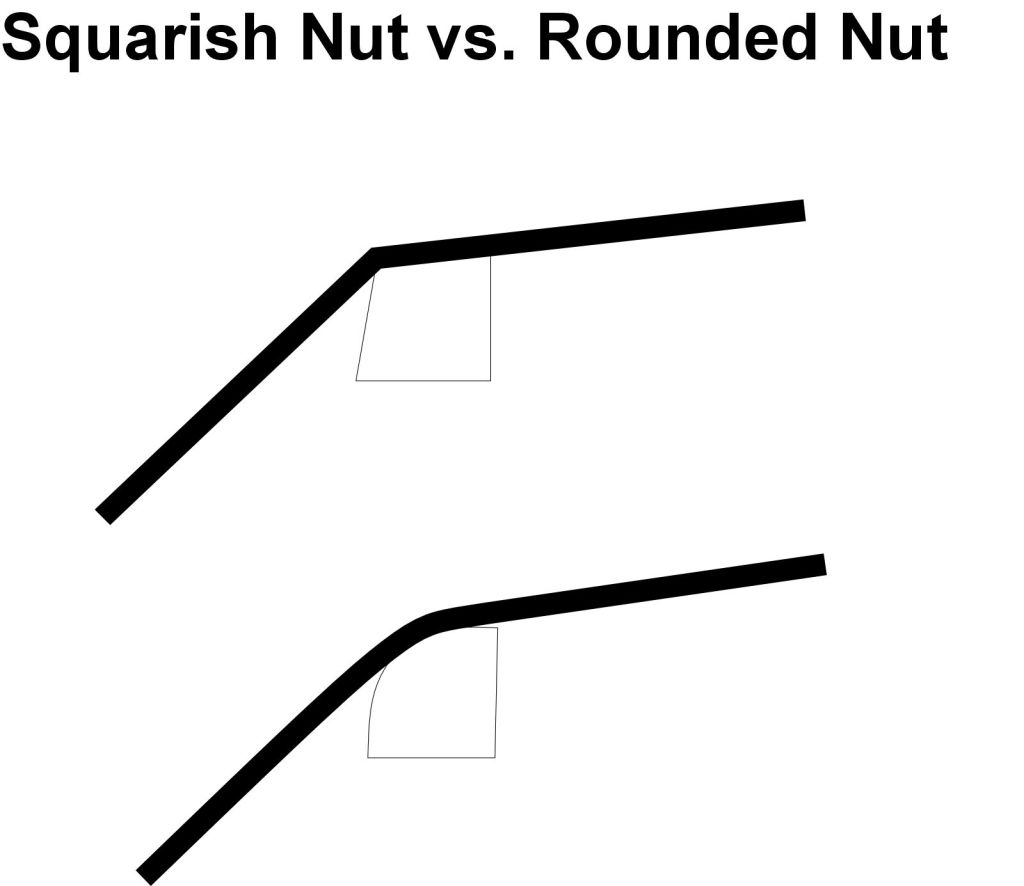
A nut with a smooth rounded edge rather than a more squarish sharp edge increases the size of the string bend radius (i.e. R). I have already explained why a larger bend radius results in lower tensile and compression strain. Figure 1 illustrates how nut shape helps.
Figure 1:
Better Nut Material
If you are going to optimize the nut shape, there are also better nut materials. For example, nuts made from a polymer marketed as GraphTech XL. This material, which comes in black or off-white, looks exactly like ebony or ivory respectively. This material is self-lubricated and is 500% more slippery than ebony, bone or ivory. It solves the user error of insufficient lubrication described in Part I.
Thinner fingerboard
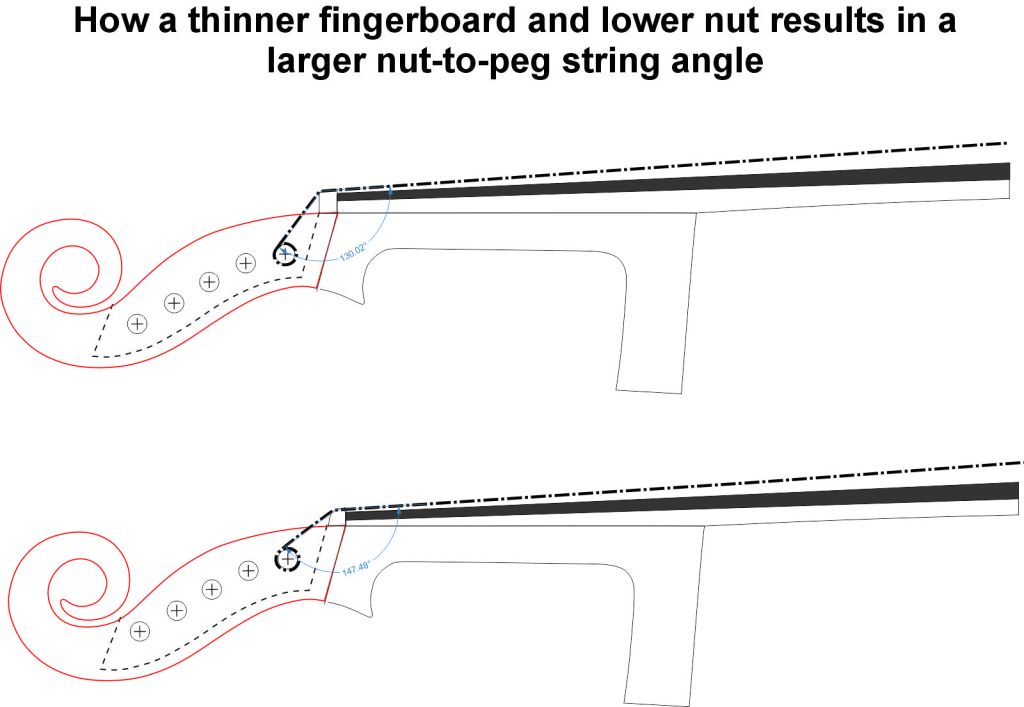
A thinner fingerboard means a lower nut. Figure 2 illustrates how this, together with modifying peg hole geometry increases the bend radius substantially.
Figure 2:
Modified peg hole geometry
In my experience, peg holes for Violoncellos da Spalla and other tenor/baritone alternative bowed strings are drilled in the same positions as standard large violas or violins. This means that the pegs are positioned much lower in the pegbox and much closer to the nut than optimal for large-diameter strings. Just drilling the peg holes 2mm higher and 2mm further from the nut makes a significant difference vis-à-vis straightening out the string angle at the nut.
Part III conclusion
This concludes the three-part series on pre-mature string breakage. Hopefully I have given players and makers information that you did not already know about how to keep your precious Violoncello da Spalla, Octave Viola, Tenor Viola and Octave Violin strings from breaking before their time.
As always, thanks for your attention.
Contact Information
The web address for the “Cool Instruments for Hep Cats” video podcast is: @Cool_Instruments_for_Hep_Cats – https://www.youtube.com/@Cool_Instruments_for_Hep_Cats/podcasts
Don Rickert’s main website, ‘D. Rickert Musical Instruments’, is https://www.RickertMusicalInstruments.com.
Online store, ‘Don Rickert Musician Shop’, is https://www.DonRickertMusicianshop.com.
Don Rickert on Linktree: https://linktr.ee/donrickert. This link gets you to ALL of my detailed contact information, my websites and social media.
Email: don@donrickertdesign.com; doctorfiddle@gmail.com
Phone (in US): 706-400-1481 (mobile)


Leave a Reply