
Part II
This is a continuation of Part I, which focused on User Error.
Part II: Attributes of the Strings and the Instruments Themselves
While user error can account for, in my experience, at least 50% of premature string breakage, there are other things that are completely under the control of instrument makers, including myself. I have jumped ahead, so let’s back up a bit.
So, besides user error, there is another contributor to premature string breakage on Violoncellos da Spalla, Octave/Tenor Violas and even Octave Violins. This has to do with the sheer physical diameter of the lowest strings. The fact is, most low-pitch tenor/baritone ranger bowed string instruments are simply not built to take large-diameter strings into account. The instrument geometry simply does not accommodate large-diameter strings. Put another way, the angle of the strings over the nut and to the pegs is too “sharp”. See Figure 1 below.
Figure 1:
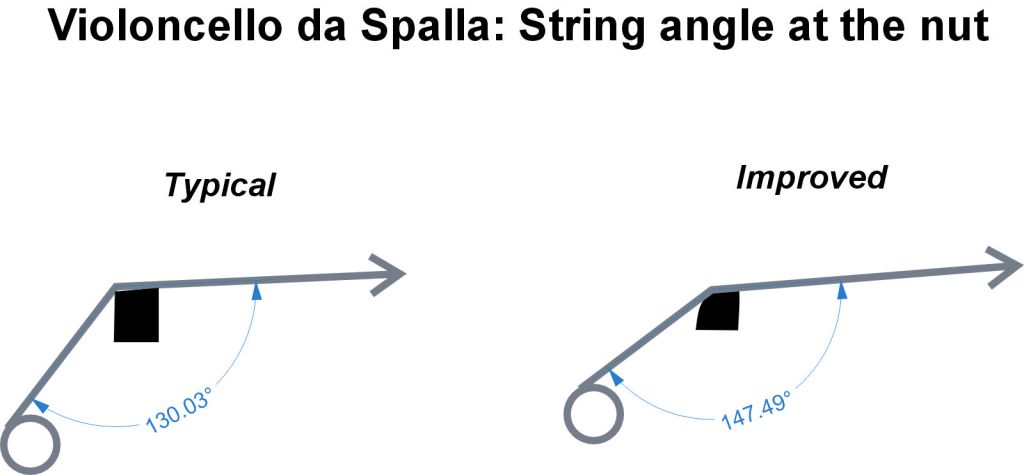
More than most of us instrument designers and luthiers want to admit, our lower than standard pitched instrument designs are simple extrapolations from traditional instruments. This will be addressed in Part III.
Does string angle really make a difference?
Yes, the thicker the string, the more “sharpness” of the “bend” at the nut matters.
String angle at the nut
Here is a good starter question: If you have two pieces of wire or stiff gut cord, one twice as thick as the other, is there going to be any difference in the strain when the pieces of wire or cord are bent at the same angle? This question is grounded in reality. The lowest string on a Violoncello da Spalla or Octave Viola (C2) is usually about twice as thick as the lowest string on a regular viola or 5-string fiddle. It is exactly what happens if you put Octave Viola Strings on an unmodified viola.
Yes, there is a significant difference with respect to strain. The thicker wire or cord will experience twice as much strain as the thinner wire or cord when bent to the same angle (or radius of curvature).
Here is the breakdown of why this happens:
The Mechanism of Bending Strain
When you bend a straight wire, the material behaves differently depending on where it is located relative to the bend:
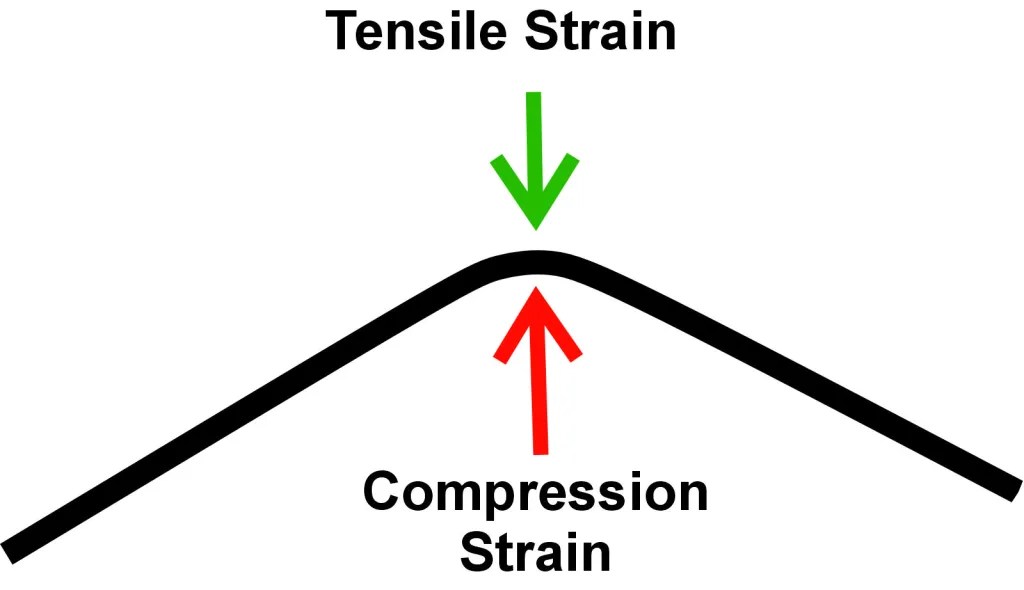
- The Inside Curve: The material on the inside of the bend is compressed. This is called compression strain.
- The Outside Curve: The material on the outside of the bend is stretched. This is called tensile strain.
- The Neutral Axis: Right down the exact center of the wire, there is a line that neither stretches nor compresses. There is zero strain.
See Figure 2 below.
Why Thickness Changes Everything
Here is a very simplified scientific explanation.
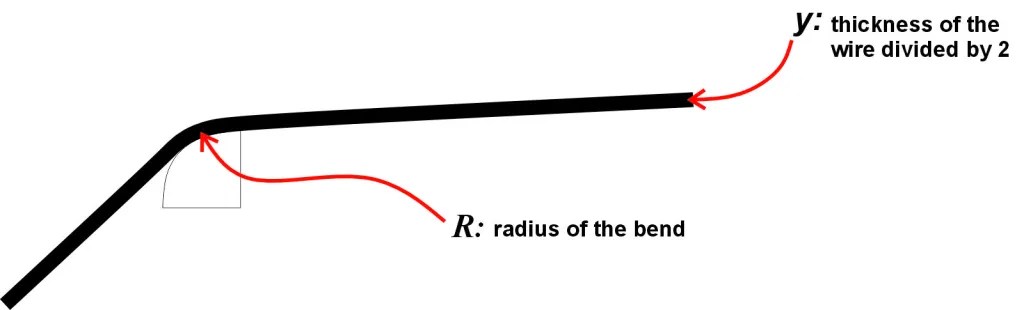
Bending Strain (E) is directly proportional to the distance from the neutral axis to the outermost surface (y), and inversely proportional to the radius of the bend (R). See Figure 3 below:
Figure 3:
The mathematical formula is:
E=y/R
For a round wire, the maximum distance from the center to the outside edge (y) is simply half of its thickness (same as the radius of the wire’s cross-section, (r)).
If you bend two wires to the same angle over the same curve (keeping (R) constant):
- A Thinner Wire: Has a smaller distance from its center to its outer edge. The material doesn’t have to stretch very far to accommodate the bend. Similarly, the material on the inner edge does not have to compress very much.
- A Thicker Wire (2x thickness): The outer surface is twice as far from the neutral center line. Because that material is forced much further away from the center, it has to stretch twice as much to cover the outer arc of the bend. Similarly, the inner edge of the curve compresses twice as much.
The lower-pitched musical strings are not a simple wire or cord. They are a wire or gut core, overwound with one or two layers of thinner wire. The effect of compression or tensile strain is considerably more significant on the relatively fragile outer windings than a solid wire. Anyone who has ever had a string break in the pegbox will observe that the windings break (i.e. fray) before the solid core.
What This Means in Practice
Because the maximum strain is doubled in the thicker wire, it will be much harder to bend, will generate significantly more internal stress, and is much more likely to permanently deform (yield) or snap compared to the thinner wire at that same angle.
Part II Conclusion
Part III will discuss features of the instruments themselves and the strings that can be changed to reduce premature string breakage, holding user error constant.
Contact Information
The web address for the “Cool Instruments for Hep Cats” video podcast is: @Cool_Instruments_for_Hep_Cats – https://www.youtube.com/@Cool_Instruments_for_Hep_Cats/podcasts
Don Rickert’s main website, ‘D. Rickert Musical Instruments’, is https://www.RickertMusicalInstruments.com.
Online store, ‘Don Rickert Musician Shop’, is https://www.DonRickertMusicianshop.com.
Don Rickert on Linktree: https://linktr.ee/donrickert. This link gets you to ALL of my detailed contact information, my websites and social media.
Email: don@donrickertdesign.com; doctorfiddle@gmail.com
Phone (in US): 706-400-1481 (mobile)


Leave a Reply