
Part I
For many folks who play Violoncello da Spalla, strings seem to break far more frequently than with regular violins, violas and cellos. That is because they do. Almost as if “the universe” has a sick sense of humor, the string that breaks most frequently is the C-string. Of course, it is the most expensive and hardest to find at any price. For more about the string availability crisis, see: The String Crisis with Octave Violas (Chin Cellos) and Violoncellos da Spalla.
Often the C-string does not even make it through installation before breaking! Another $50 to $100 string down the toilet. This is true for Octave Violas as Well as Violoncellos da Spalla. Tenor violas and Octave violins do not have C-strings, so the C-string is not an issue with them.
The second most frequent breakage string is, you guessed it, the G-string. They are, at least, less expensive and easier to find. Fortunately, a long or extra-long medium to heavy-gauge viola C-string unusually works very well as a VdS G-string. Yes, I said a VIOLA C-string.
From my experience, the treble strings (D, A and E for Violoncellos da Spalla or 5-string Octave Violas and 5-string Octave Violins) do not generally break prematurely. An exception is when players install a viola D-string as a VdS E-string, tuning it UP to E4. This is a tension break rather than a friction break described below. For this reason, many players actually use a viola A-string for the violoncello da spalla E. On many instruments, a low-tension E-string sounds better anyway; definitely less strident.
Note about the cover image to the post
The observant reader will notice that the introductory graphic more or less defies the laws of physics. That is because it is AI-generated (Google Gemini)! I asked Gemini for an image of a Violoncello da Spalla with its C-string broken in the pegbox. I decided to use the graphic for its comedy value. AI is smart like a human engineering student with perfect SAT scores and good grades, but is an idiot when it comes to art, aesthetics, literature, philosophy, musical instruments, etc.
So, why do violoncello da spalla C and G strings break so frequently?
There are two main reason categories for premature string breakage with Violoncellos da Spalla and the other tenor/baritone bowed strings being discussed (i.e. octave violas, tenor violas and octave violins). The first, and you may not want to hear this, is user error. The other is structural failure, having to do with, either directly or indirectly, the incredibly large diameters of the lowest strings on these instruments.
Part I: User Error
This could be you. Possibly half of premature C and G-string breakage is due to user error. The “user” can be the player or a violin shop employee, whoever it is who is installing strings.
Here are the main reasons.
Binding against the peg box wall
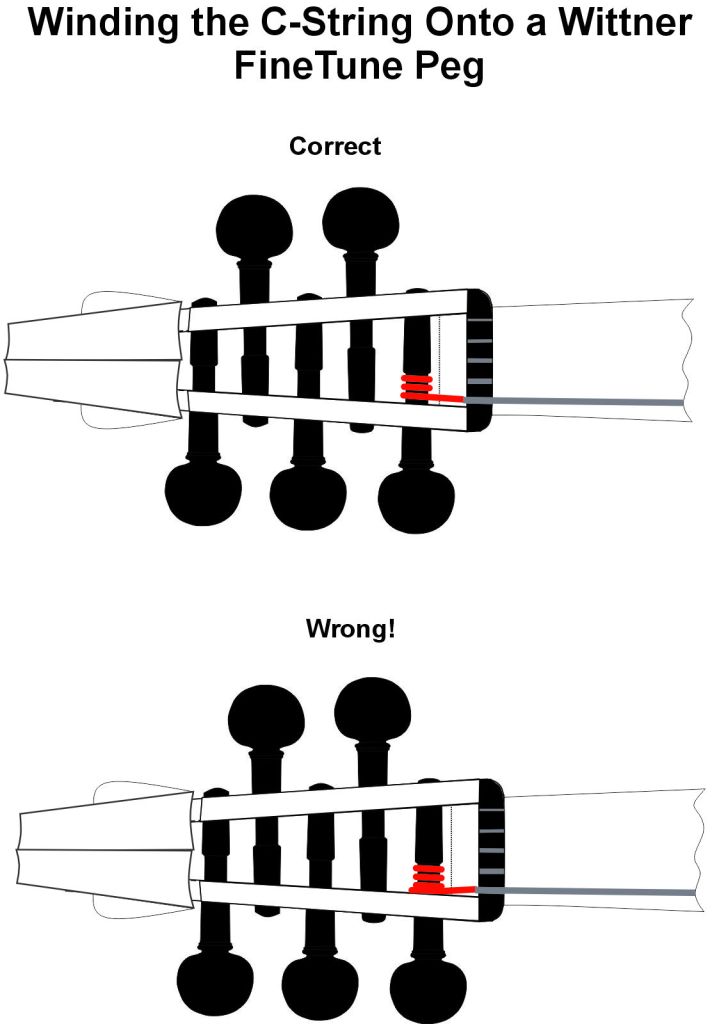
Inexperienced players, or mechanically challenged players, will often just wind an untrimmed string leader (the part wound with colored silk or cotton thread) so many times around the peg that the string ends up binding against the peg box. It is amazing how many alleged “luthiers” at local violin shops will make this mistake as well. I believe that this is due to widespread lack of experience with “fat string” instruments such as cellos da spalla, octave violas or even octave violins.
Anyway, if you wind the string so that it touches the pegbox and there is a 100% chance of breakage between the peg and the nut as the string is tightened.
The pegbox binding problem and the solution are illustrated in Figure 1.
Figure 1:
Note: User error that applies to gut core strings only
- Failure to moisten and kneed the tailpiece end prior to tying the tail knot or loop.
- Failure to moisten and kneed the leader end prior to winding onto the peg.
Large diameter gut strings are very brittle and require more flexibility prior to use. The varnished “silked” part of strings is even more brittle until softened.
Incorrect nut and/or bridge string grooves
At the Bridge
Grooves that are too small on the bridge contribute to the bridge leaning forward. Too small means that the groove is smaller than the string diameter, contributing to excess friction at the bridge tip. It can also lead to breakage at the bridge; however, this is not that common. The bridge tilting forward and warping, or even breaking, is not that common in my experience; but this post is about string breakage.
At the Nut
Nut grooves that are too small are a much bigger problem. If the string binds at the nut, the string is going to break between the nut and the peg—guaranteed!
On instruments by master luthiers, and even many factory-made instruments, the string grooves are generally right for the strings that are initially installed. The problem arises when replacing the original strings with another brand that are larger in diameter. For example, An Aquila (https://aquilacorde.com/) wound-gut C-string has a larger diameter than, say, a Boussoir (https://www.atelier-boussoir.fr/boutique/) silk-core string. Every player should own or have access to a digital caliper and a set of high-quality nut groove files. While readily available (e.g. Amazon), a nice caliper runs about $35 and a complete high-quality nut file set runs about $250—not cheap! I am actually thinking of including calipers and nut files with new instruments.
Don’t count on your local violin shop having either digital calipers or proper nut files on-hand, as unbelievable as that sounds. Why, because strings for Violoncello da Spalla and other tenor-baritone bowed string instruments are very much thicker than standard strings. The problem of string grooves that are too small is rare with regular violins, violas and cellos, and typical violin shop repair persons seem to get by without specialized tools like special-purpose nut files or digital calipers. A lot of them seem to muddle through with small files, sandpaper, and their eyes. I don’t know; that is the only explanation I can come up with. On the other hand, I can guarantee you that any decent guitar shop will have these tools.
Note: There are exceptions when it comes to violin shops having the right tools and knowhow. For example, my favorite shop, Atlanta Violins in Roswell, GA. Their owner, Matt Phillips, is one of the finest repair/restoration luthiers I have ever known, He teaches me things.
Unlubricated string grooves
Any written or video instructions for violin, viola or cello string replacement will mention lubricating the string grooves on the bridge and, especially, the nut. I have observed that most players ignore this advice. With regular violins, violas or cellos, one can often get away the lack of lubrication. With the very large diameters of violoncello da spalla strings, lubrication is critical. Using a standard graphite pencil to lubricate is often insufficient. Note: pencil “lead” is actually graphite. One should use a specialized string groove lubricant, which is readily available, including online retailers such as Sweetwater, Guitar Center and Amazon. It usually comes in a tube and has the consistency of Vaseline. The lubricant I use is called MusicNomad TUNE-IT Guitar String Nut and Saddle Lubricant. It is widely available on sites such as Amazon for about $10 for a tube.
Part I Conclusion
Part II will discuss features of the instruments themselves and the strings that are associated with premature string breakage, holding user error constant.
Contact Information
The web address for the “Cool Instruments for Hep Cats” video podcast is: @Cool_Instruments_for_Hep_Cats – https://www.youtube.com/@Cool_Instruments_for_Hep_Cats/podcasts
Don Rickert’s main website, ‘D. Rickert Musical Instruments’, is https://www.RickertMusicalInstruments.com.
Online store, ‘Don Rickert Musician Shop’, is https://www.DonRickertMusicianshop.com.
Don Rickert on Linktree: https://linktr.ee/donrickert. This link gets you to ALL of my detailed contact information, my websites and social media.
Email: don@donrickertdesign.com; doctorfiddle@gmail.com
Phone (in US): 706-400-1481 (mobile)


Leave a Reply