
Introduction
I just posted an article, in three parts, about premature string breakage on Violoncellos da Spalla, Octave Violas, Tenor Violas and Octave Violins. Here are the links to those articles
- The Premature String Breakage Problem with Violoncellos da Spalla, Octave Violas, Tenor Violas and Octave Violins: Part I – User Error
- The Premature String Breakage Problem with Violoncellos da Spalla, Octave Violas, Tenor Violas and Octave Violins: Part II – Attributes of the Strings and the Instruments Themselves
- The Premature String Breakage Problem with Violoncellos da Spalla, Octave Violas, Tenor Violas and Octave Violins: Part III – Proposed Changes to Instrument Design
Below is a high-level summary of the three articles listed above.
Part I – User Error
Strings for Violoncello da Spalla and other tenor/baritone bowed strings do frequently break prematurely.
This is especially true for the lowest strings, C2 and G2.
Strings are getting harder to acquire and they are getting more expensive.
See ‘The String Crisis with Octave Violas (Chin Cellos) and Violoncellos da Spalla’.
General reasons for premature string breakage
At the highest level, there are two categories of problems contributing to premature string breakage.
- User error
- Problems associated with large string diameters
User Error
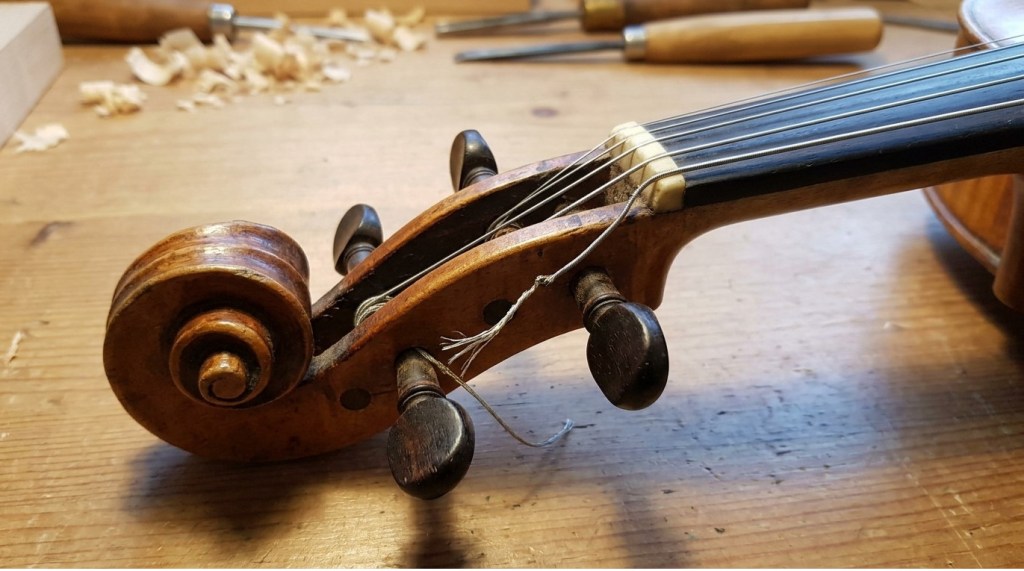
Binding against the peg box wall
Gut strings specifically
- Failure to moisten and kneed the tailpiece end prior to tying the tail knot or loop.
- Failure to moisten and kneed the leader end prior to winding onto the peg.
Incorrect nut and/or bridge string grooves
Specifically, this means grooves that are smaller than the diameter of the strings. The necessary tools for measuring string diameter and cutting the nut grooves are discussed as well. These are:
- Digital calipers
- Nut groove files
Unlubricated string grooves (bridge and nut)
- Friction causes string breakage. Lubrication reduces friction.
Part II – Attributes of the Strings and the Instruments Themselves
Most low-pitch tenor/baritone ranger bowed string instruments are simply not built taking large-diameter strings into account.
String angle at the nut
The thicker the string, the greater “sharpness” of the “bend” at the nut matters.
The Mechanism of Bending Strain
The thicker the string, the greater the strain. There are two kinds of strain.
- Compression strain
- Tensile strain
Both types of strain cause breakage.
Part II goes into some detail about the science behind compression and tensile compression as they relate to string breakage.
Part III – Proposed Changes to Instrument Design
This is a continuation of Part II, which focused on attributes of the strings and the instruments themselves vis-à-vis premature string breakage. Part III focuses on what can be done about it.
Changes to instruments that will decrease premature string breakage
Thinner strings?
The result of means that the string has lower compression strain and tensile strain at the nut; thus, a GREATER angle. While it is quite possible to make custom strings that are thinner, this is not a practical solution presently.
Better Nut Material
I advocate use of self-lubricated nut material, specifically GraphTech XL. With this material, no user behavior change is necessary.
Structural modifications that increase the string angle at the nut
Better nut shape
A nut with a smooth rounded edge rather than a more squarish sharp edge increases the size of the string bend radius (i.e. R), and thus, decreased string breakage.
Thinner fingerboard
A thinner fingerboard means a lower nut. This also increases the size of the string bend radius (i.e. R), and thus, decreased string breakage.
Modified peg hole geometry
Drilling the peg holes 2mm higher and 2mm further from the nut makes a significant difference vis-à-vis straightening out the string angle at the nut.
Contact Information
The web address for the “Cool Instruments for Hep Cats” video podcast is: @Cool_Instruments_for_Hep_Cats – https://www.youtube.com/@Cool_Instruments_for_Hep_Cats/podcasts
Don Rickert’s main website, ‘D. Rickert Musical Instruments’, is https://www.RickertMusicalInstruments.com.
Online store, ‘Don Rickert Musician Shop’, is https://www.DonRickertMusicianshop.com.
Don Rickert on Linktree: https://linktr.ee/donrickert. This link gets you to ALL of my detailed contact information, my websites and social media.
Email: don@donrickertdesign.com; doctorfiddle@gmail.com
Phone (in US): 706-400-1481 (mobile)


Leave a Reply